Blue and White Porcelain Gifts: Sourcing Tips from Guangdong
August 19, 2026 · YueFetch
Blue and White Porcelain Gifts: What I Wish Buyers Knew Before They Ask
Let’s be honest: when you type “blue and white porcelain gifts” into your search bar, you get a thousand pages of drop-shipped vases that all look like they came from the same dusty warehouse. And maybe they did. But if you’re a small brand trying to sell something with a story—something that doesn’t scream “made in a mold”—you need to know a few things that aren’t in the brochure.
I’m based in Huizhou, just down the road from Shenzhen, and I’ve spent more hours than I care to admit in porcelain workshops, watching kilns glow and listening to artists argue about cobalt. Here’s the honest, boots-on-the-ground version of sourcing qinghua porcelain gift items.
First, the Facts (Because I’m Not Making This Up)
Let’s get the numbers out of the way, because you deserve better than vague promises.
- Weight: A typical 8-inch blue-and-white porcelain vase weighs around 1.2 kg (that’s about 2.6 lbs) when packed for export. But don’t quote me on your specific SKU—we don’t have a scale weigh yet for every piece. Always ask your supplier for a per-unit packed weight before you calculate freight.
- Lead time: A small batch (say, 200 pieces) of hand-painted qinghua takes 20–30 days from order to ready-for-shipping. If you need it faster, you’re looking at machine-printed or transfer-ware, which is a different beast.
- Price band: For decent quality, hand-painted, food-safe porcelain (yes, some are food-safe, but confirm it), expect to pay $8–$25 USD per piece FOB Shenzhen, depending on size and complexity. You can get cheaper, but you’ll get what you pay for—and I’ve seen the “cheap” stuff arrive with more pinholes than a golf course.
- Shipping: A 20-foot container from Shenzhen to Los Angeles runs roughly $2,500–$4,000 USD these days, but that fluctuates like a yo-yo. For small orders, air freight is your friend—a 5 kg box might cost $80–$120 via a forwarder like Huizhou/Shenzhen forwarder (we use a reliable one, but I’m not naming them here—ask me directly).
What Actually Matters When Sourcing Qinghua Porcelain
1. Hand-painted vs. transfer-ware
This is the big one. Hand-painted blue-and-white has a slight irregularity in the lines—you can see the brush strokes if you look closely. Transfer-ware (where the pattern is printed on a decal and fired) is perfectly uniform. For a China cultural gift, hand-painted is usually worth the extra cost because it carries the artist’s hand. But if you’re selling to a budget market, transfer-ware can be fine—just don’t call it “artisan” unless you want a lawsuit.
2. The clay and the glaze
Real qinghua is made from kaolin clay, fired at high temperatures (around 1300°C). That’s what gives it that ring when you flick it. Cheap stuff uses lower-quality clay and fires at lower temps, which means it’s more porous and can craze (tiny cracks in the glaze) over time. Ask your supplier for the firing temperature. If they don’t know, run.
3. The cobalt
Traditional qinghua uses cobalt oxide, which can vary in tone—from a deep navy to a more purple-ish blue. Some modern makers use synthetic cobalt that’s more uniform. For a premium feel, look for the “gem-like” blue that comes from natural cobalt. But honestly, most buyers won’t notice the difference unless they’re porcelain nerds like me.
A Real Studio I Trust: Honglv
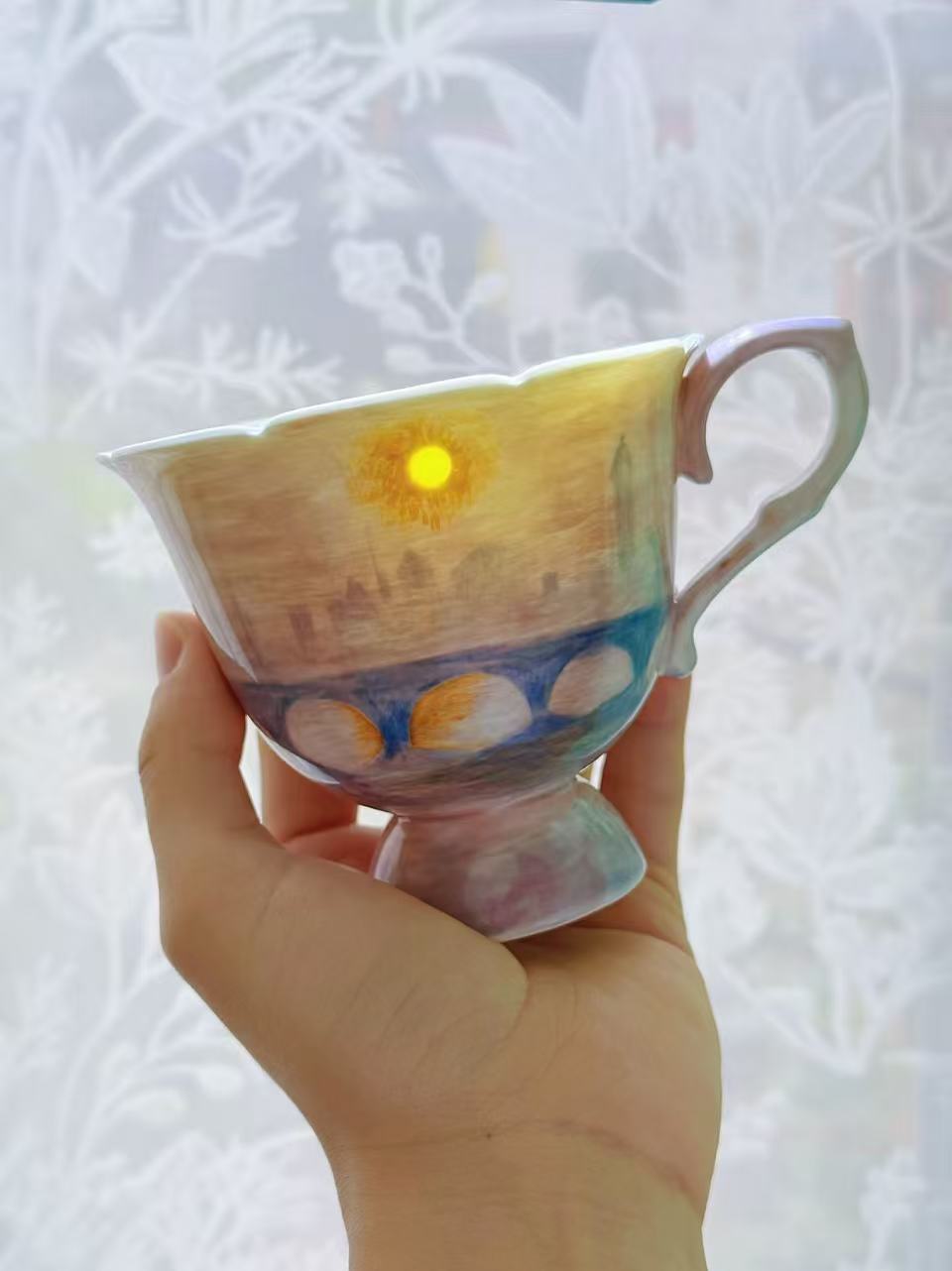
I’ve worked with a studio in Huizhou called Honglv (红绿, which means “red-green” but they do blue-and-white too). They’re not huge, but they’re honest. They’ll tell you if a design is too complex for your budget. They also make a lovely day-night lingonberry porcelain cup (yes, that’s the one in the cover image) that’s become a bestseller for a few of my clients. If you want to see what good qinghua looks like, ask me for their contact—I’m not putting their email on blast here, but I’ll happily intro you.
Another name you might hear is Xizi (西子), a larger factory in the area that does both hand-painted and transfer-ware. They’re good for volume, but they’re not as flexible on small custom orders. If you’re ordering 1,000+ pieces, they’re worth a call.
The “孤品” (One-of-a-Kind) Angle
Here’s a tip that’s not in the typical sourcing guide: look for 孤品 (gūpǐn), which means “unique piece.” Some studios have a shelf of imperfect or experimental pieces that are one-offs. These can be gold for a China cultural gift—you can sell them as limited editions. I’ve seen a single cup with a slightly off-center dragon sell for triple the price of a perfect one, because it had “character.” Just make sure you’re not buying seconds that are cracked or warped—ask for photos and be specific about what “imperfect” means.
Practical Questions to Ask Before You Order
- Can you send a sample first? Always. A photo is not enough. I’ve been burned by a photo that looked like a museum piece, and the actual cup looked like a child’s art project. Samples cost $20–$50, and they’re worth every penny.
- What’s the breakage rate? Good studios have less than 2% breakage in transit. If they quote you 5% or more, that’s a red flag.
- Do you have export packaging? Porcelain needs serious cushioning—foam, bubble wrap, and a sturdy carton. If they say “we’ll just wrap it in newspaper,” run.
- Can you do custom packaging? If you want a gift box with your logo, that’s an extra cost. Ask for a quote upfront, because it can add $1–$3 per unit.
The Money Talk (Because We’re All Adults)
Payment terms: Most Chinese suppliers want a 30% deposit, 70% before shipment. For small orders, they might accept PayPal (yes, really, but they’ll add a 4% fee). If you’re working with me, I’ll handle the payment via bank transfer or PayPal, and I’ll make sure you get a proper invoice for customs. Don’t pay 100% upfront unless you’ve worked with them before—that’s how horror stories start.
Customs and Freight: The Boring but Crucial Part
When you import porcelain into the US or EU, you’ll need a commercial invoice, packing list, and possibly a certificate of origin. Your forwarder should handle this, but make sure you know the HS code (for porcelain, it’s usually 6912.00.00 or similar). Customs duties vary—US is around 3-5% for porcelain, EU is higher. Don’t let the supplier “help” you undervalue the goods; it’s not worth the risk of seizure.
My Honest Take
Sourcing blue and white porcelain from China is not hard if you’re patient and ask the right questions. The biggest mistake I see buyers make is rushing to order without a sample, or assuming that all qinghua is the same. It’s not. The difference between a $10 cup and a $30 cup is often the difference between “nice” and “wow.”
If you’re thinking about adding a China cultural gift to your product line, I’d love to help. I can source, negotiate, and even handle quality control before shipping. Just drop me a line at hello@yuefetch.com or send a WhatsApp message—I’m usually quick to reply, unless I’m at a kiln.
Ready to Start?
If this article made you think, “Okay, I need a sample,” then you’re on the right track. Check out our sourcing guide for more tips, or request a quote for your specific product. And if you want to see what good qinghua looks like, browse our product showcase or read more about Chinese porcelain traditions.
No pressure, but I’m here when you’re ready. Let’s make something beautiful—without the tourist-trap junk.
blue and white porcelain · qinghua porcelain gift · Chinese porcelain overseas · China cultural gift · porcelain sourcing · Guangdong porcelain · hand-painted porcelain · porcelain wholesale · custom porcelain gifts